Agentic Knowledge Engine
BuildWiki: The Agentic Knowledge Engine for Australian Construction
We transform noisy, fragmented community data into a verified, high-trust knowledge source for the residential building industry.
Engineering the Truth
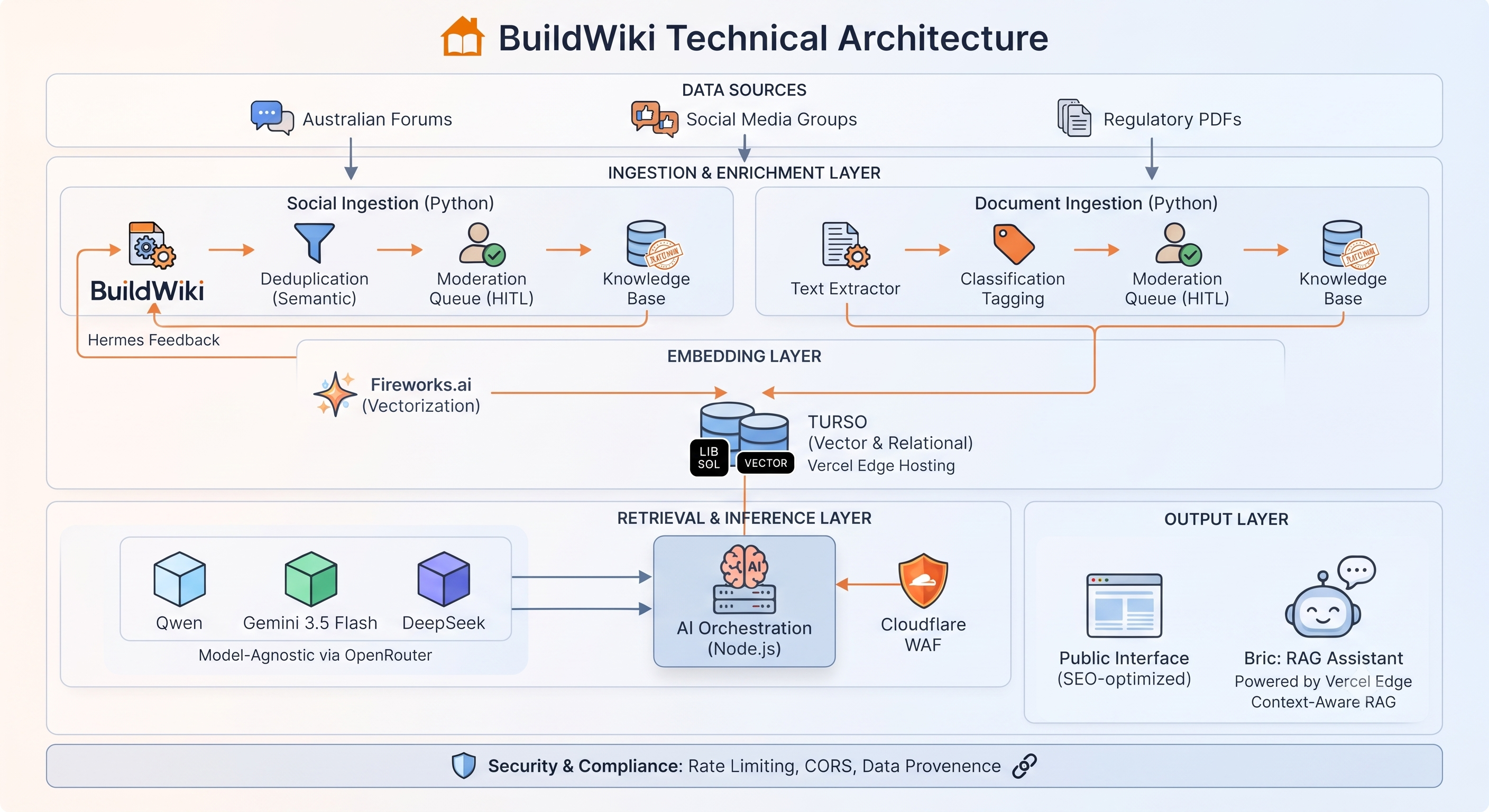
We operate a high-signal ingestion pipeline that moves beyond simple vector search. By integrating a human-in-the-loop (HITL) moderation layer, we ensure that only factually accurate, tagged, and vetted knowledge enters our RAG engine.
Our “Hermes” agent tracks moderator corrections, continuously optimizing our automated extraction logic. This is not just a chatbot, it is a self-hardening knowledge infrastructure.
Engineering Walkthrough
A technical breakdown of our production-grade pipeline: from automated social ingestion and vector-space deduplication to our model-agnostic inference layer.
Why BuildWiki is Different
Most RAG systems focus on retrieval quality but assume the underlying knowledge corpus remains reliable. As content grows, duplicate information, outdated discussions, inconsistent tagging, and low-quality sources can gradually reduce retrieval precision and increase maintenance overhead.
BuildWiki is designed to continuously improve the quality of its knowledge base rather than simply indexing more content. Our architecture combines:
“Every moderation decision becomes training data for our ingestion pipeline, enabling BuildWiki to improve extraction quality, reduce duplicate content, and strengthen retrieval accuracy over time. Rather than accumulating technical debt as the knowledge base expands, the platform is designed to become more accurate with every moderation cycle.”
The Workflow
Data Sources
IngestionAggregating raw community discussions, forum threads, and regulatory documents from high-signal Australian sources.
Ingestion Engine
AutomatedPython-based extraction of key discussion points, FAQs, and tips, tagged via automated classification.
Deduplication
Semantic FilteringDeterministic comparison of new content against approved stores using semantic similarity to eliminate noise.
Embedding
VectorizationGenerating high-dimensional vector representations via Fireworks.ai, stored alongside provenance metadata.
HITL Moderation
Human-in-the-LoopManual gate for content validation, tag administration, peer review, and final content editing.
Hermes Feedback Loop
Self-ImprovingAutonomous agent consolidation of moderator edits to programmatically refine ingestion prompts and logic.
Hybrid Indexing
Search ArchitectureMulti-layered index combining semantic vectors, structured metadata, and keyword matching for precision.
Output Surface
FrontendSEO-optimized public interface serving structured, vetted knowledge artifacts.
RAG Assistant
BricContext-aware conversational interface grounding answers in cited, verified sources with sub-1.5s latency.
AI Model Strategy
Pluggable Model Architecture
Our ingestion and RAG pipeline implements a provider-agnostic adapter pattern. We can natively configure Gemini, DeepSeek, or local Ollama instances as primary endpoints, or route through OpenRouter to access an expansive library of alternative inference models.
Dynamic Routing
We maintain primary/fallback configurations that allow us to switch inference providers based on task complexity, token costs, or service availability, ensuring our system remains resilient to provider-specific outages.
Infrastructure Stack
Data & Persistence
We leverage Turso as our unified database layer, handling both structured relational metadata and high-dimensional vector embeddings for semantic search.
Edge Deployment
The platform is deployed via Vercel, utilizing their edge network to ensure low-latency, global availability for the RAG assistant and public site.
Why Our Tech Scales
The Self-Improving Advantage
Unlike static knowledge bases, BuildWiki features a closed-loop ‘Hermes’ agent. It monitors human moderation edits and programmatically refines our ingestion extraction logic. The more we moderate, the more accurate our engine becomes.
System Health Metrics
Knowledge Trust Model
Provenance
Every knowledge artifact is linked to its verified source discussion thread.
Grounding
The RAG engine is strictly restricted to vetted artifacts, minimizing hallucination risk.
Auditability
The Hermes agent maintains a full log of manual corrections for internal oversight.
Security & Compliance
API Security
Rate limiting, CORS hardening, and injection prevention on all endpoints.
Content Provenance
Every indexed item carries traceable source metadata with moderation history.
Building the Future of Construction
BuildWiki was founded to solve the information asymmetry that plagues the Australian construction industry. We are a team of builders and software architects committed to democratising home-building knowledge through verified, high-trust AI infrastructure.